The First 24 Hours Set the Entire Drying Timeline
The clock that matters most is the one that starts the moment water touches your floor. Within the first 24 hours, clean water from a supply line can begin migrating into wall cavities, wicking up into baseboards, and saturating the cushion under your carpet. If we arrive within a few hours of the loss, we are often dealing with a wet but intact structure, which means the drying window stays inside that three to five day range. If the water sat for a full day or longer, the timeline shifts because saturated drywall, soaked insulation, and waterlogged subfloor all hold moisture in ways that fans alone cannot reach. This is why our 24 hour emergency response in Rockville exists, not as a marketing line but as a practical reality of how water behaves once it escapes a pipe or appliance.
On a typical first visit, our Rockville Water Restoration crew arrives with truck mounted extractors, moisture meters, thermal cameras, and a full count of air movers and dehumidifiers staged for the size of the affected area. We extract every drop of standing water we can pull, because removing one gallon by extraction is roughly 1,200 times faster than evaporating that same gallon with air movement. We map the moisture in your walls and floors, mark the boundary of the wet zone in pencil if needed, and document everything for your insurance carrier. That documentation is what turns a hopeful claim into an approved one, and it is built into our process on day one rather than added later. The thermal camera reveals cold spots where evaporative cooling is still happening behind a surface that looks perfectly dry, and the penetrating moisture meter confirms what the camera suggests, which together let us see the full footprint of the loss rather than just the visible puddle.
Day Two Through Day Five: What Drying Actually Looks Like
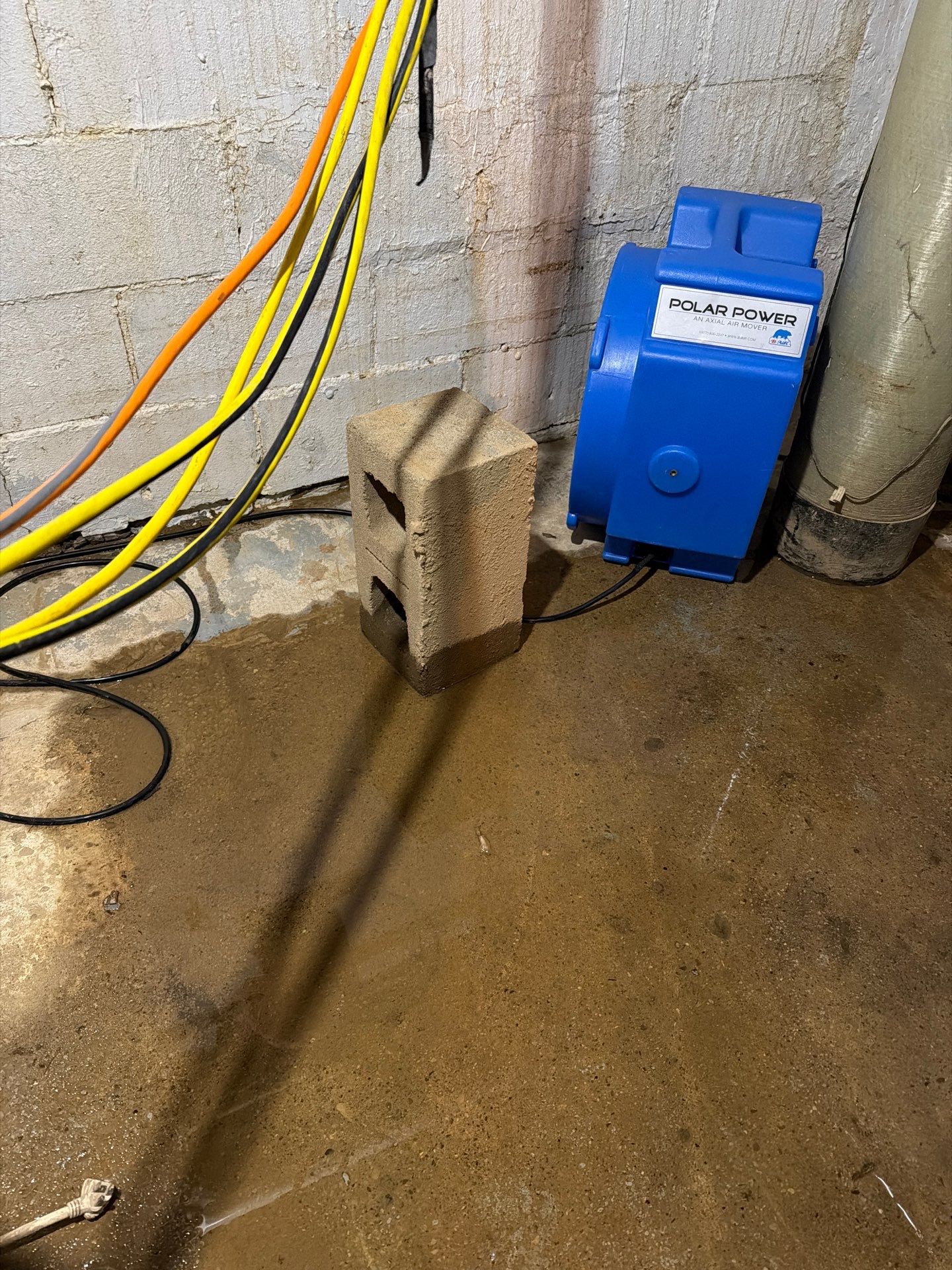
Once equipment is placed, the real work is invisible. Air movers run at angles that create laminar airflow across wet surfaces, lifting moisture into the air, where commercial grade dehumidifiers pull it out and drain it away. A standard residential dehumidifier in your basement does maybe 30 pints a day. The LGR and desiccant units our crews bring can pull 130 to 240 pints a day, and that difference is the entire reason a professionally dried home reaches the IICRC S500 standard of drying within four to five days rather than the two to three weeks a homeowner with rental fans might need. By day two, surface materials usually feel dry to the touch, but the meters tell a different story. Subfloor readings, baseboard cavities, and the bottom plates of framing often still hold double digit moisture content, and pulling equipment too early is the single most common cause of mold complaints we see when we are called in as a second opinion.
Day three is the checkpoint where we know whether the plan is working. Readings should be trending down at a steady rate, and if they are not, we adjust. That might mean drilling small weep holes at the base of drywall to allow airflow into the cavity, removing a section of baseboard, or floating the carpet to push warm dry air underneath. By day four or five on most clean water losses, readings reach equilibrium with unaffected areas of your home, and we begin the demobilization process. For category two losses, often called grey water, the timeline can extend by a day or two because more material has to be removed before drying begins. Our grey water category two cleanup process includes antimicrobial treatment, controlled demolition of contaminated porous materials, and a slower, more careful drying phase that protects your indoor air quality.
Why Some Jobs Take Longer Than a Week
Not every loss fits the standard timeline, and a senior technician will tell you that on the first walkthrough rather than pretending otherwise. Hardwood floors, for example, can take seven to fourteen days to dry properly with specialty mat systems that pull moisture out from below without cupping the boards beyond what can be sanded back flat. Plaster walls common in older Rockville neighborhoods hold moisture far longer than modern drywall, and they often need targeted heat drying rather than ambient airflow. Crawl spaces and basement slabs with no airflow take longer simply because the environment fights you, and category three losses involving sewage almost always require demolition before drying can even start, which is covered in detail in our black water category three emergency cleanup guide. Outdoor temperature and humidity in Rockville also play a role, since a dry winter day with the furnace running pulls moisture out faster than a humid August afternoon when your dehumidifiers are working against the weather itself.
Building construction adds another layer of variation that is easy to miss until you are standing in the middle of the project. A two story home with a finished basement and water that traveled from an upstairs bathroom is essentially three drying environments stacked on top of each other, each with its own airflow patterns and material mix. Tile floors with thinset over a wet substrate can hold moisture for ten days or more because the tile itself is a vapor barrier, which is why we sometimes recommend pulling a few tiles strategically to release the trapped humidity below. Cabinetry, especially particle board built ins, behaves unpredictably because the glue holding the panels together breaks down once it gets wet, and what looks salvageable on day two can swell and delaminate by day four. Recognizing those failure points early is part of what an experienced crew brings to the job.
How We Communicate the Timeline to You
The honest answer to how long your water damage will take to dry is this: we can usually give you a confident range after the first inspection, and we can give you a firm answer after the day three moisture check. What we will not do is promise three days and stretch the job to seven to pad the invoice, and we will not pull equipment early to free it up for another job. Every drying log is shared with you and your adjuster, and the equipment stays in place until the numbers say the structure is dry. You receive a daily update from the lead technician, a copy of the moisture readings in writing, and a clear explanation of what changed since the previous visit. That transparency is the difference between a restoration project that feels like an ordeal and one that feels like a problem being solved on a predictable schedule by people who do this every day in Rockville.